Sunday, December 10, 2023

Update

It's been some time since I posted anything new, life seems to have gotten in the way. Getting old really does slow you down and makes it that much harder to keep up with everything.

Maggie and I are comfortable in our home here in Hampton, twenty miles south of Atlanta. Thanksgiving is behind us and Christmas is just around the corner. 

Four score and one years on this skinny body has taken it's toll. But, like the little ever ready bunny, it does keep on ticking, even if a bit slower now.

I don't know how much longer I will be around or able to continue the blog, I'll try to see if one of my kids wants to pick it up, if not I'll look to others to continue the effort.

Sunday, January 31, 2016

1604 Parish Records


From the original (photo copy above) documents, St Botolph Parish, Aldgate, London, April Anno 1604:


"Thomas Rockhould and Parnell Trott were maried the twelft day"


Our Robert Rockhould was born about 1605 (best guess), his son's name Thomas could well have been after his Grandfather.


While I have nothing other than speculation and name association to base my opinion on, I think I may have found my Ninth Great Grandparents.


Thursday, January 14, 2016

Henry Pettit, my 4th GGF:

Twelve year old Henry Pettit, my  4th GGF (my maternal GM’s line) stood in his father’s stead as a soldier in the Revolutionary War.  He is well documented in pension records and history books, but I find most interesting his own personal account of his war time activities as he recounted then in his 1832 application for his pension (Rev War Pension File W5528)


The following is a personal account of his service in the Revolutionary War.


Henry Pettit
(Revolutionary War Pension File W5528)            
           To the best of my recollection in the year 1776, my father was then living in South Carolina 96 [District 96], now Spartanburg District on Lawson Forks of the Pacolet.  We was called on to build a fort known as Wofford Fort.  I then volunteered myself in place of my father who was at work on the Fort.  Col. William Wofford was Commander of the Fort. I was under the command of Capt. James Wood.  This service began about the 1st of June and lasted to the 1st of November.  About that time the families generally went home.  This service was possibly in endeavoring to keep the Tories and Indians from Embodying.  We had many a chase after them. 
          My next service was when Ferguson and Dunlap marched their army through South Carolina into North Carolina.  On their passage they was met by the Americans at Brown Oats Field.  There was several killed.  I was sent from that place with an express to Col. McDowell to reinforce.  We pursued them, after being reinforced, to Musgroves Mill on the [unclear] River where we overtook them and defeated them in this service sweep under Capt. James Smith and Col. John Thomas, Commander.  We all returned home.           
          I was then placed under captain Henry White.  We scouted through the upper part of South Carolina to the border of North Carolina.  We took a good many Tory prisoners on our arrays in the neighborhood.  We was ordered on to meet the Main Army at Shier’s Ferry under General Sumter.  When we came to that place, they was in sight of us, that is the British and Tories.           
          There was some fighting across the River.  From that Post we was ordered on to Black Stock where we had a severe Battle.  Gen. Sumter was wounded at that Place.  The volunteer part of the Army pursued after them under Col. Lacy to the mouth of Tyger (?) River where we overtook a Party and had an engagement.  We went on down the river some distance and crossed to the east side.  In passing up the Country, we took a good many prisoners.  We came on the Main Army and gave the prisoners up to them.  I was then under Capt. Trammel and Dickson.  We was ordered on then to join General Morgan.  We joined him at the Grindle Shoals on the Pacolet.  We scouted on and met him again at Licketty.  We then kept with the army after the Battle of Cowpens.           
          In that Battle, I was wounded in my thigh which injured me very much.  At this time, as soon as I was able, I enlisted in the ten months service under Captain William Smith, first under Col. Thomas, then under the command of Col. Middleton.  We was marched to the Country below Columbia, kept in continual movements from one point to another from the Savannah to the Congaree and near to Charleston.  We had many skirmages, they had the better of us and sometimes we paid them back in their own caves.  We joined the Main Army some few days before the Battle of Eutaw Springs.  I was placed as one of the guards of the Baggage Waggons on that day.  If I could have had a choice, I would have been in the battle in preference of my station.  After the battle we was ordered up the country, {and} turned to Orangeburg.  We had a scrimmage near Orangeburg with some of their Rangers.  We had to give the ground to them.  We met another party above Orangeburg where we had an engagement.  They fled to the Swamp.  We pursued them and they escaped to Charleston.                
          About that time the British began to leave their Country Posts and take to their stronghold in Charleston.  We followed on after them occasionally annoying them, to the 4 Holes where we made a stand for a few weeks to search the swamps between the 4 Holes and the Cyrees.  From there we was at Round S and then on the Near Macon’s Bridge from there to headquarters.           
          We heard of the capture of Cornwallis and our times that we enlisted for was expired and we returned home.
          In fact, for me to undertake to give in detail my service during the Revolutionary War is not in my power, but one thing I do know well is that from sometime after the summer of 1776 to the end of the war, I was engaged in the Defense of my Country.  I then lived in the hottest part of the Tory Country on the Indian Boundary and a great place for the British to assemble.  We that belonged to the Liberty Party was compelled to be in readiness at all times. 


Sunday, February 1, 2015

Early Land Records, Virginia Colony

Digging through the Virginia Library on-line http://www.lva.virginia.gov/public/using_collections.asp#_guides
 I found some land records:

19 August 1637 (image 001_0462) Patent land grant of 250 acres to Robert Rockwell for transporting his wife, children and servant.  Robert Rockwell, Sarah Rockwell, Mary Rockwell, Thomasin Rockwell and Mary Mayor.

This indicates to me that Robert Senior had previously arrived as the grant did not state "for the transportation into this colony of himself and..."  Additionally, in spite of the grant stating, "his wife, children and servant", I think that the "Thomasin" just might be Robert's mother.

20 July 1639 (image 01_0682) Patent land grant of 250 acres to Robert Rockwell for transporting Thomas Rockwell, Mary Roo and three others that I cannot read.

To me this Thomas, who it seems was very young at the time. would not have traveled out of the colony and returned two years later.  I believe Thomas was left behind when the rest of the family traveled in 1637.  This is why I think the 1637 Thomasin is the mother, not the son.

16 October 1645 (image 02_0069 and image 02_0070)  Land survey of 250 acres due of patent granted 16 November 1638.

I have yet to find the patent that this survey is for.  Nor can I find the land survey for the 1637 or the 1639 grants.  Historically the grants were often sold before the land was claimed and those transactions are indexed under the name that is the owner of the grant, not necessarily the same person to who the grant was issued.


I can email these images to anyone who might want them, I realize it's a bit hard to read here.  Send me your email via a PM on Facebook.

Friday, January 23, 2015

About the Search

Europe , through the thirteen and fourteen hundreds, was conflict upon conflict.  The English kings were constantly trying to uphold their positions and standing.  The French, the Scots, the Irish, the Welch, and others were all warring against the Kings at some time or another.  The Kings were fighting with the nobles, the nobles with the peasants, the clergy with the faithful and the unfaithful.  It was not a very calm, friendly environment.

The fifteen hundreds brought a different kind of war, one pitting the church against the crown, and the followers of the various emerging protestant churchs against the crown and "church".  The thirty years of the civil war created some strong rifts between those who supported the "church" and those who felt that there was a god given right to life, liberty, and happiness, and to worship in the manner that they felt was right for them.

Robert Rock* (name as on earliest found documentation) was born probably between 1600 and 1605.  He was likely born in England but could have been born in the Netherlands.  While no documentation, there is sketchy information that his father was one Richard Rockwell who died about 1621 in Fitzhead, Somerset, England.  Richard was the son of William Rockwell and Marion Wyke (or Pyke or Kyne); he married Thomazine Littlejohn in Fitzhead, September 1593.  This Thomazine could be the Thomasin that arrived in Virginia in 1637 under the sponsorship of Robert.  It appears that Robert's son Thomas arrived in Virginia a little later than the initial arrival of the other members of the family.
* Appears to be "Rockwell" on the land warrant; many read it as Rockhould.

Considering the interchanging of the Rockhould, Rockhold, Rockholt, Rockwell names over the years, it is not a long stretch.  History tells us many Puritans were not willing to convert to the religious ilk's of the English royals and some left England for the Netherlands in the early 1600s, before any real colonization  of America.  This leads me to believe that Robert and maybe Samuel Greniffe did relocate to the Netherlands and then at a later date on to Virginia.

Robert married Sarah Greniffe about 1633, probably in the Netherlands where sons Robert Junior and Thomas, and daughter Mary were born.  The family immigrated first to Virginia colony around 1637, as reflected in land records of the time.  Daughter Ann and son John were born in Virginia.  The family relocated to Maryland colony around 1649.

Robert was an armourer (gunsmith) by trade but the family became very successful farmers with several hundred acres, mostly in tobacco.  All of the first generation, Robert Jr., his siblings and their wives died in Maryland.  Their descendents moved eventually to the corners of the new world, as it grew.  Today there are relatives found with three variations of the family name; Rockhold, and Rockholt as well as Rockwell.  The family Rockwell does not always trace back to Robert, there is a separate line of the Rockwell family originating in Massachusetts  around the same time Robert came to Virginia.  Could the two lines be connected?  Very well could be but I have not found a solid connection yet.

I favor the idea our Robert, who could be the son of Richard Rockwell of Fitzhead,  was a brother or cousin of William Rockwell, father of the New England Rockwell family.  If, and it's a very big if, Robert left England under penalty of arrest (which could have occured over even a trivial matter) he would have changed his name since the arrest warrent would have followed him to the colony.  I support this idea with the documentation of the use of Rockwell by a few of the second generation individuals.  Also, I have found some information regarding the history of the name itself:  "Rockwell, formally Rockholt; from old English, hroc (rook) + holt (wood), of Buckinghamshire and Somerset".

I thought I had a good lead on another Rockhould family in England, around the time Robert would have left, but it turned out to be a Rockwell that was indexed as Rockhould.  I have also found some Rockholts in Sweden, I have yet to gain any contact with them but I am trying.  There are also some Rockholt's in Germany,  I have not found anything that would tie our family to Germany.There is not a lot of documentation existing that allows us to trace the family forward from Robert's arrival in Virginia until we begin to get extensive data in the America of the mid 1800's.  Some land records and  a few probates of wills along with a very few surviving family bibles are about all we have that can be considered reliable.  The early histories of Virginia and Maryland contain some information on the early families, the Rockhould/hold/holts, the Todds, the Warfords, the Dorseys, the Richardsons and others are often presented in totally different lights in the various histories.  It seems that there just might have been a little bias towards some and against the others.

Until 1850, when the United States census began to list all members of the household by name, it is a very difficult task to piece together the lineage from one generation to the next.  Even after 1850 it can be imposable.  The 1890 census was destroyed leaving twenty years, from the 1880 census to the 1900 census, with very little information to work with.  Also, early records were often made with names spelled wrong, children visiting with family  members were sometimes recorded as son or daughter of the head of household when in fact they were a niece or nephew.  Orphans and step children were often misidentified.

The children of Alfred Rockhold/holt and Elizabeth Sisk, who accompanied Elizabeth to California, are good examples.  They are identified with the surname of their stepfather on one census.  As both Rockhold and Rockholt  they emerged into adulthood.  Alfred's second wife, Elizabeth Presley, was only identified as Elizabeth on the census records and was thought to be the same  person as Elizabeth Sisk until the marriage document for her and Alfred was found.  It probably is even a leap of faith to believe that the two Elizabeths were the wife of our Alfred, I think it's a reasonable assumption considering everything that has been found.

Another great question is whether or not Elizabeth Presley was Presley by birth or by marriage.  Some of the Presley family attest the name to marriage to one John Presley, but no marriage documents have been proven, and there just doesn't seem to be any good evidence to support the idea.  While there is good evidence of a single Elizabeth, in the area, of the right age to marry Alfred, there is just no good evidence that the two young Presley boys living with Alfred and Elizabeth were not hers by a previous marriage.  While they could well be her nephews, there is nothing to prove that they are.

Duplicate names, especially the more common given names of the family, such as William, Alfred, and Robert often create questionability.  In one case I have identified three individuals with the same name, near the same age in Tennessee in 1860.  As the family increased in numbers, as the years went by, it becomes even a greater problem.  Until the early 1900's death certificates did not exist, and births were only recorded in church records and family bibles.  In the few instances where state/colony records were kept they were mostly kept only long enough to prepare an "indexed record".  These records are often filled with errors in transcription from the originals.

The Mormon church has done extensive work in transcribing and indexing historical records.  The federal and many state census records, old military records and extensive collections of family trees are made available on the web site "ancestry.com".  For anyone looking into the family lineage the cost of subscription to "ancestry" is money well spent.  While several of us, descendents of Robert, are working to research and document the family line we can always use and request that you provide us with any information that you might have available.

Saturday, October 18, 2014

Family History (at least what I have found)

History And Origin of surname “ROCKHOLT”

Variant of German Rockolt, a variant of Rocholt, or Rocholl; thought to be from variants of a Germanic personal name composed of the elements hrok ‘prudance’, ‘care’ + wald ‘rule’, and by others to be of Slavic origin.

From all I have been able to determine, our ancestors immigrated to America from England, maybe through the Netherlands. While there is great evidence of German movement into England prior to the 1600’s, there is little recorded history from which information can be gathered. The early family was mostly protestant or puritan, and as such were surely victims of religious persecution, probably the cause of their immigration. Some of the wives of the earliest found American Rockholts were of Welch and Scottish birth, leading me to believe that the early Rockholts did associate with English settlers.

Virginia Colony seems to be the earliest settling, in the 1600’s. From there they moved into Maryland and down into Tennessee. Many of the family men worked on the railroads in the 1800’s, into the Carolinas, Georgia and Alabama, eventually scattering across the expanding nation, While there is today a large number of Rockholts in Tennessee, they are also concentrated in Texas, Arkansas and California.

Variants of the name, be they the result of intentional or unintentional change, have been found while researching the family genealogy. While today our line spells the family name “ROCKHOLT”, it appears also as Rockhold or Rockhould, and Rockwell. Where only a single use of alternate spelling was found, I retained the more prevalent spelling. Where there were several instances of alternate spellings, I have included both, listing the less prevalent in parenthesis.

I must acknowledge the assistance that I received from family members, both close and distant. They have proven to be a valuable asset, providing both leads and photographs. A special thanks to a schoolmate of mine, Glenda Fox Boyajan, she was such a great help in researching documentation from various sources.

Information contained in this genealogical tree has been collected from census records, birth and death certificates, marriage license filings, military records, bible entries, newspaper articles, obituaries and burial records, and in a few instances from personal history.

There can never be a complete, totally accurate genealogy, there are new events occurring, births, deaths, marriages and divorces which need to be included. There is also the matter of interpretation; choices that I have made, when there exists such extreme differences that it is unclear exactly what the correct information is. The listing of Grandfather Rockholt as Walter William, and not William Walter, was a matter of choice. While I found significant reference for William Walter or William W., and little for Walter William, and the fact that all of the personal reference was “WW Rockholt”, my memory of the time that he spent with my family is that he was “Walter”, and that is what I used for my decision to list him as Walter William. When Grand dad died and his grandson Tommy was handling the final arrangements, he too knew Grand dad as Walter William and that is what is on his death certificate and tombstone. [Note: I have since discovered documentation that allowed me to see where Grand dad, in his own hand, did sign as “William W. Rockholt”, and changed my listing on the family tree.]

My Family Tree: on ancestry.com rockholt (mrockh)
Family Group Page: on Facebook: Rockholt Family Search
My Search Blog: http://michaelrockholt.blogspot.com/

I am always looking for additional members of the family and additions to the information I have listed, and of course, identification of any errors that might exist in the tree that I have developed. Specific reference identification or actual scans of the source documents will be included, when provided. Feel free to contact me:

Michael David Rockholt

Thursday, September 4, 2014

A distant cousin, James Boatwright; 1833-1896

James Boatwright, cousin to my 2nd Great Grandfather Joshua Boatwright, was a prominent South Carolinian and it seems he was an awful lucky survivor of the Civil War. The following is from, "The Confederate Veteran, February 1900" (A newspaper dedicated to and for, the Confederate Veteran).


Boatwright,-James, Captain-Text: p.88  Confederate Veteran February 1900.-

We record the death of Capt. James Boatwright, Company B, Fourteenth South Carolina Regiment, McGowan's Brigade, of Ridge Spring, Edgefield County, S. C. He was born in Columbia, S. C., January 18, 1833, and died September 13, 1896. His grandfather Boatwright, for whom he was named, was one of the earliest settlers of Columbia, and one of its wealthiest and most prominent citizens. To his mother's people were granted in colonial times most of the Ridge lands of Edgefield County, S. C. His great grandfather Watson was an officer in the revolutionary war, and was buried with military honors. An uncle of Capt. Boatwright's uniformed a company of Hampton's Legion, C. S. A. It was originally known as the Watson Guards. Capt. Boatwright was well educated. He was a cadet at the South Carolina Military Academy at Charleston. At the age of twenty seven years he left his wife and child on a lonely, isolated plantation and went as lieutenant. In the battle of Ox Hill, Va., the captain was wounded and resigned, when Lieut. Boatwright became captain. He had many narrow escapes from death. His first service was on the coast of South Carolina. The  Yankee gunboats were shelling  Port Royal. He was standing in the road and saw the shell coming. Fully expecting to be killed, he turned sidewise, the shell passed him, blackening and bruising his limbs and tearing off the skirt of his new jeans coat, the cloth of which had been woven on his mother's plantation. This shell killed four men. Capt. Boatwright saw hard service in Virginia. At Spottsylvania during the battle a man was lying with his head against Capt. Boatwright's knee, when a cannonball took the man's head off, leaving Capt. Boatwright spattered with his blood and brains. Among the hard fought battles he passed through were the Wilderness, Fredericksburg, Cedar Mountain, Bull Run, the second Chancellorsville, Spottsylvania, at Petersburg on both sides of the James River, seven days' fight around Richmond, and the three days' battle at Gettysburg. At the battle of Gettysburg Capt. Boatwright's company went in with fifty four men, and after the three days' battle reported eight men for duty. The company had sixteen men killed on the field of battle, and every officer wounded except Capt. Boatwright, who was in command of the regiment at the close of the battle. The gallant Gen. Abner Perrin, in his account of the battle of Gettysburg, says: "Capt. James Boatwright was distinguished for uncommonly brave conduct in this battle, as I can testify from personal observation." At the surrender of Lee's army at Appomattox, Va., Capt. Boatwright stuck his sword up in an old stump and made his way home on a black horse which had been captured from the Federal army at Spottsylvania. It belonged then to Dr. Hugo, surgeon of the Fourteenth Regiment. Caesar, the faithful man servant of Capt. Boatwright, considered himself one of "the boys," for many a lark did he go on with them. He ever had an eye to the welfare of "Marse Jimmie." He was twice married, and left seven sons and four daughters. The home life of Capt. Boatwright was beautiful. He loved his home beyond all places on earth, his wife and children constituted his world. He was a man of few words, no pretenses, sincere, and unostentatious. He was to his children a companion and friend. In middle life he enlisted under the banner of the cross in the Protestant Episcopal Church.

Wednesday, August 20, 2014

A distant Uncle on Mother's side: He died in service for a cause.

(James) Carrol Jameson (1830-1864), brother of my 3G Grandmother (Frances
(Jameson) Perry) died of apparent food poisoning.  This is an interesting narrative,
of one H.M. Singleton, of his death.

From: "Operations of A.C. Earle's Cavalry Company, U.D.C. Vol. II, page 37-
39, Some Recollections of a Confederate Veteran, H.M. Singleton"

"I was a member of Capt. A.C. Earle's Company, made up of South Carolina soldiers
from Pickens, Anderson and Greenville. We were ordered to report to General W.E.
Jones, commanding a brigade of cavalry in West Virginia. We soon found ourselves into
it. Gen. Jones had orders to hold the railroad from Lynchburg, Virginia to Bristol,
Tennessee, at all hazards. That, every soldier knew, meant something. We had to ride
over rough mountains and cross large rough rivers, through the cold, wet, mud. Where
Gen. Jones was, there was his headquarters also. We had no winter quarters or tents.
We were moving all the time day and night.

In November, 1863, we were ordered to meet Gen. Longstreet at Knoxville, Tennessee,
which was a long rough march. I was put on provost guard with twenty-five of our
company at Bristol, Tennessee, to guard our army stores, depot, etc. We had to guard
prisoners and ship them to headquarters. On the 3rd of January, 1864, 12 of us boys
were detailed to carry 13 deserters from Longstreet back to their command, then
in camp at Morristown, Tennessee. We had three days rations in our haversacks,
blankets, guns and forty rounds of cartridges to carry. It was forty-five miles to
Morristown, through a thinly settled section of county filled with bushwhackers, which
made the journey all the more perilous. This trip was made on foot. We were formed in
a line and the prisoners in another, the order read out from headquarters to shoot if
any resistance was made by the deserters. It was the coldest weather we had ever saw
and remained so for about a month. It snowed every day or two and took 13 days to
make the trip. We were not used to walking and the snow and ice soon wore out our
shoes and socks and our feet were sore and bleeding, but we had no way to help it. We
arrived at Holston River at Rogersville. The ferryman informed us that it was a mile
across and mush ice floating in the river and it was hard for us to get along. We all got
over safe and found the snow ten inches deep with a thick crust on top. We tramped
hard that day in order to reach Morristown. Late in the evening we came in sight. We
reported to Gen. Jenkins and turned the prisoners over to the guard and went and drew
two days rations and camped there for the night. No pen can picture or tongue tell of
the suffering with cold and hunger, beside our blistering and bleeding feet. But it was
still worse getting back to the command. It was 85 miles back through snow and ice with
only two days rations and no chance to buy anything or nothing ot buy with. We got
back to Holston River that night and camped under a bluff near the bank and kept from
freezing by scuffling, jumping, and skinning a cat on a big oak limb. Next morning
the river froze over and we were compelled to cross on the ice. That day was clear with
awful cold wind.

We crossed the Holston River on the ice. After we had all crossed safely, we sat down
and gave thanks to our Heavenly Father. We marched on that day and camped out that
night and sent out two of our men to buy or beg something to eat, for we had eaten
frozen biscuit until we were tired of them. When they returned and informed us that they
had the promise of some warm biscuit and fresh mutton for breakfast it made us all feel
better. The weather was still very cold and we would not allow anyone to sleep for fear
of freezing. Next morning we got out the mutton and biscuit and divided it out soldier
fashion for we did not know when we would get any more and started on our march in a
big hurry for our time was out. But before we had gone five miles we all began to get
very sick and had nothing to give relief and nowhere to lie down except on the cold ice.
We soon found out that we had been poisoned for the cold biscuit had a peculiar smell
that would gag us. Now death was preferable to life. By vomiting up all we had eaten
and not drinking any water we all lived through the day and struck up at camp that night.
Next morning two of our men fell at the camp, James Barrott and Carroll Jamison,
neither of them could walk a step. Jamison died, Barrott survived.

We carried them to a house and left them with a good lady and she took care of
them. When Jamison died she had a nice walnut coffin made and buried him at a
Baptist Church.. His name was put on a board at the head of his grave and
marked as follows,"Carroll Jamison of Co. B, 37th Batallion Va. Cav., of Capt. A.C.
Earle's Co., S.C." Barrott reported for duty in about 15 days. We had been gone so
long and marched so long in the cold that we were unable for duty sometimes.

We spent the winter and spring scouting the country around Bristol, Tennessee, to the
Cumberland Gap, taking many prisoners and a number of army stores and forage. The
suffering of the soldiers that winter will never be told.

Early in the spring we moved to Saltville, Virginia, still guarding the railroad and other
public works along that road. We routed them at that place but they kept cutting through
and going on until we captured everything they had and routed them completely. Capt.
Earle was ordered to Saltville again to guard the salt works, for that was an important
place for it supplied the southern army with salt. I shall never forget Capt. Earle for he
was kind. He did not allow any of his company to suffer if he could avoid it. May the
Lord reward him for his kindness to us all. May the Lord bless all the officers of our
company. I will always remember Lieut. J.A. Griffin and Orderly T.P. Looper for that
noble sprit they exhibited with many others. Some have crossed the river."

Notes about H.M. Singleton:
Enlisted in Greenville, S. C. June 10, 1863, in Co. B., 27th Virginia Cavalry. He was
absent, wounded on Nov. 1863-Aug 1864 roll. Admitted Richmond Hosp. Aug 16,
1864.

H.M. Singleton is not found in A.C. Earle's Company in Broadfoot's Guide to Men in
Service from South Carolina. He is listed as having served in the Twenty-Sixth S.C.V.
There is also a Henry M. Singleton listed in Company G of Orr's Rifles. Carroll Jamison
and James Barrott are not shown in the company rolls either. C. Jamison is listed as
having served in Company C of the Sixteenth S.C.V. and there is a Carrol Jamison
listed as serving in Company E of the Second South Carolina Rifles. The Rifles
would have been with Jenkins Brigade, the unit the prisoners were delivered to.
James Barrott is listed as serving with First S.C. Artillery spelled as James Barrett.
Carroll Jamison is listed in Broken Fortunes by Kirkland as having died in
Tennessee serving with Company B of the Thirty-Seventh Virginia Cavalry. This
illustrates perfectly the imperfections of the information found in the Compiled Service
Records and other service records of the Confederate Era. It also shows the importance
of alternate sources like the U.D.C. books, Confederate Veteran, and the Southern
Historical Journal.

Friday, May 2, 2014

When Mother died, what happened to the children?

When Grandmother, Martha Eugenia (Boatwright) Rockholt, died in 1928 the children were farmed out to various family members and friends.  Trying to find just where and with who they went is proving to be a real challenge.

I did manage to find Uncles Fred  Allen  (1912-1986) and Robert Earl  (1915-2003).  In 1930 they are found in the census for Big Springs, Benton County, Arkansas, Monte Ne.  The census is annotated Ozark Industrial College.  The boys, then 18 and 16, are found in the residence of Rev. Arther and Nellie Williams, minister at Holnest Church.  The Ozark Industrial College and School of Theology operated from 1927 to 1932.  Housed in two large log hotels (which had previously operated as resort hotels), ran by Dan Webster Evans under the sponsorship of the Pentecostal Holiness Church.

The fifteen acre location was self sufficient, the students maintaining the gardens and performing household chores for their room and board.  The boys were housed in one of the units, while the girls were housed in the other.  It seems that the school was not able to maintain the mortage payments and they were closed down.  The buildings and amphitheater were consumed by Beaver Lake in the early 1960's.

Uncle Fred was a lemo driver, a deputy sheriff for a while, and mostly ranch foreman.  Uncle Robert was in construction, mostly industrial and agricultural buildings as I remember, but I did not have a lot of interaction with his family.

                                            The Amphitheater at Monte Ne
                                            Part of the Monte Ne complex

Information on the Ozark Industrial College:

Information on William "Coin" Harvey, builder of Mount Ne: 

Grace Rockholt (1920-1980) the youngest of the two girls, is found in 1930 Springfield, Greene County, Missouri census in the household of Edward F.  and Annie Jackson.  Annie's maiden name was Boatwright, she was the sister to Grace's mother (my grandmother) Martha Eugenia Boatwright.  Best I can figure out Annie's name was Jo Annie Mable Boatwright (10 Feb 1881 - 29 Oct 1939); married Edward 27 Jan 1901.

Grace was injured during WW II while serving in the Womens Army Corps (WAC).  As I remember being told, she fell from a second story window while washing windows and was paralized from the injuries.

I have yet to find any information on where Arbie Lee and the youngest boy, Joseph David Rockholt were sent when their mother died.

Additional Information:

I have since found JD:  (Joseph David Rockholt, b. 20 Apr 1927) In 1930 Porun, Muskogee, Okla census with Sam Wiley and wife Susie Elizabeth (Boatwright), his mother's sister.  (He is listed as Uncle, additional annotation as "relative").  In 1940 he is still with Sam and Susie in Porum (as Jonah Rockholt).  In 1945 he enlisted in the Army at the age of (just barely) 18.  He is in and out of the military, serving two additional enlistments in the Air Force.  Arbie is still in the wind, I cannot locate her early life.


Thursday, May 1, 2014

Martha Eugenia Boatwright

My paternal Grandmother, Martha (Mattie) Eugenia Boatwright, was born on July 26th, 1891 in Franklin, Stone County, Arkansas.  Her father, Marcellus, was 42 and her mother, Mary Hooper, was 40.  She married my grandfather, Walter William Rockholt on April 24th, 1908, three months short of her seventeenth birthday.  (27 July 2014:  I have since determined that grandfather's name was actually William Walter, not Walter William.)

In 1910 (U.S. Census, May 1910) my grandparents are living with Mattie's family in Martin Township, Muskogee County, Oklahoma, along with my father, William Franklin who is just a little over a year old.  1920 census has the family, Walter, Mattie, William (Dad), and two brothers, Fred and Robert, sister, Arbie Lee, and Grandfather's brother, Uncle Clint, in Diamond, Haskell County, Oklahoma.

Grandmother died on the 25th of May, 1928 in Sebastian County Arkansas.  Dad had already left home, the other children were scattered about with friends and family.  Granddad, a gospel minister, bounced around a lot, often spending time with his children and their families.  He died in Arizona October 1980.

The Boatwright line traces back to England in the mid 1600's, and probably (but unproven) to the early Viking settlements in Northern France in the late 9th century.  The Normans were Vikings who began to settle in northern France in the late 9th century. They soon adopted the French language and Christianity. The Normans protected the French coast from foreign attacks. In the year 1066 an army of Normans under Duke William (later called "the Conqueror" crossed the English Channel and defeated the English king Harold at the Battle of Hastings. Among the Normans were ship carpenters known as "Boatwrights". The earliest reference to this surname dates back to the fifteenth century where one John Botewright is recorded as living in Suffolk County, England in 1469.  The family name is found as Botewright, Botrite, Boatwright and Boatright in various documents and records.

In the late 1640's England was in turmoil.  The English civil war had just ended, the victorious Puritans would soon behead King Charles I and Oliver Cromwell was having fits trying to establish his protectorate. Supporters of the monarchy found that England was no longer a safe haven for them.  They could loose their wealth and even their lives if they remained in England.

I believe "our" John Boatwright is the same John Boatwright baptized on October 8th, 1609  at All Saints Church, Thorpe Abbots, Norfolk, England, the son of Robert and Elizabeth.  This is based on the fact that Robert and Elizabeth had a daughter Lettice and when John grew up and married Elizabeth Cropley, they named their second daughter Lettice, probably in honor of John's sister.  The name is unusual enough that this surely is a connection.  John and Elizabeth had three children, Elizabeth, John and Lattice; Elizabeth and the girls were all buried at Saint Edward King and Martyr Church in Cambridge, England.

While I can only surmise the reasoning for John Boatwright Jr. to leave England for the new world, he did leave, arriving in Virginia as an indentured servant in 1654.  Three years later he imported eight individuals including two uncles (Thomas and William Cropley - younger brothers of his mother, Elizabeth Cropley) and his father, John Botwright, Sr. Branches of the family migrated west in Virginia, to the counties of Cumberland and then Buckingham, then into North Carolina and South Carolina during the second half of the 1700s.  Martha's great grandfather, Daniel David was established in Elbert County Georgia in 1813 when he married Elizabeth Carpenter, their son, Joshua, married Angeline Drake in 1848.  Martha's father, Marcellus Chesley Boatwright, married Mary Elizabeth Hooper on September 30th, 1880, Jackson County Alabama.  Martha was born in Franklin, Stone County Arkansas, she and Granddad were married in Franklin County.

Friday, April 4, 2014

Great Great Grandfather's Mother's family


My Great Great Grandfather, Joshua Boatwright was born 1823 in Elbert, Georgia.  I didn’t have much problem tracing his paternal line back beyond the original Boatwright immigrant, John Boatwright (1635 Fressingfield, Suffolk Co, England – 1704 New Kent, Virginia).

Joshua’s mother, Elizabeth Carpenter (1800 Madison, Virginia – 1864 Murray, Georgia) proved to be a bit more challenging.  Searching other Boatwright trees on Ancestry I found a reference to a German settlement, “Germania” in Virginia.  Seems a small band of German miners and their families were brought over by Lt Governor Alexander Spotswood (later Governor of Virginia) in 1714 to work in the silver mines, indentured for four years.  Additional settlers arrived from Germany over the next several years. This small settlement is well documented in Virginia history.

Elizabeth is descended from John Carpenter (born Johannes Zimmerman but “naturalized” as John Carpenter), born 1700, Dingolfing-Landau, Germany, and Anna Barbara Kerker, who was the daughter of a member of the second settlers of Germania. This map of Madison County shows the holdings of John Carpenter and that of Andrew Kerker (who I believe is Anna's father).


Beyond John and Anna remains unproven but it appears that John’s family is probably of Swiss origin, probably of one Michael Zimmerman, 1617 Steffisburg, Bern, Switzerland and his wife Benedicta.  There’s still more digging to prove this theory.

Working forward from John:

John Carpenter (Johannes Zimmerman); 1700 Germany-1782 Culpepper, Va
His wife: Anna Barbara Kerker

John Carpenter Jr.; 1727 Va-1795 Va
His wife: Unknown

John Carpenter III; 1749 Va-1804 Va
His wife: Susanna Delph

Jashua Carpenter; 1771 Va-1843 Va
His wife: Leah (Schmidt) Smith

Elizabeth Carpenter; 1790 Va-1864 Ga
Her husband: Daniel Boatwright; 1777 Va-1856 Ga

Their son, Joshua, my Great Great Grandfather, was named after Elizabeth’s father.

Joshua R. Boatwright; 1823 Elbert, Ga - 1900 Alabama
Angeline P. Drake; 1828 North Carolina - 1900 Alabama

Marcellus C. Boatwright; 1849 Murray, Ga - 1911 Franklin, Arkansas
Mary E. Hooper; 15 Sep 1850 Etowah, Ala - 24 Oct 1910 Porum, Muskogee, Okla

Martha Eugena Boatwright; 26 Jul 1891 Franklin, Ark - 25 May 1928 Hartford, Sebastan, Ark
William Walter Rockholt; 6 Dec 1887 North Fork White River, Ark - 1 Oct 1980 Phoenix, Ariz

My Parents:
William Franklin Rockholt; 16 Jan 1909, Arkansas City, Ark - 26 Dec 1971 Arvin, Kern, Calif
Bertha Lillian Perry; 14 Mar 1913 Keota, Haskell, Okla - 7 Oct 2004 Arvin, Kern, Calif

Saturday, March 8, 2014

LIVINGSTON COUNTY MISSOURI CEMETERY RECORDS


Name: John Rockhold
Death Date: 21 Jul 1877
Age: 63 yr., 6 mo., 27 da.
Cemetery: Utica
Description: Chula, Mo.

Name: Mary A. Rockhold
Death Date: 06 Aug 1886
Age: 64 yr., 5 mo., 25 da.
Cemetery: Utica
Description: Chula, Mo.

Name: Mary O. Rockhold
Death Date: 07 Feb 1896
Age: 70 yr., 8m
wife of James C.
Cemetery: Blue Mound Cemetery
Description: South of Chillicothe, Missouri

Name: James C. Rockhold
Birth Date: 18 Nov 1828
Death Date: 06 Dec 1903
Cemetery: Blue Mound Cemetery
Description: South of Chillicothe, Missouri

Name: Jno. Rockhold
Death Date: 05 Jan 1875
Age: 44 yr., 7 mo., 13 da.
Cemetery: Blue Mound Cemetery
Description: South of Chillicothe, Missouri

Name: Samuel Rockhold
Birth Date: 08 Apr 1843
Death Date: 05 Jun 1905
Cemetery: Utica
Description: Chula, Mo.

Name: James Rockhold
Birth Date: 1846
Death Date: 1928
Cemetery: Utica
Description: Chula, Mo.

Name: Mary Catherine Knox Rockhold
Birth Date: 08 Nov 1847
Death Date: 11 Jun 1887
wife of Spencer C.
Cemetery: Blue Mound Cemetery
Description: South of Chillicothe, Missouri

Name: Annie Rockhold
Birth Date: 18 Mar 1848
Death Date: 07 Feb 1923
Cemetery: Utica
Description: Chula, Mo.

Name: Spencer Gregory Rockhold
Birth Date: 21 Oct 1849
Death Date: 23 Sep 1879
Cemetery: Utica
Description: Chula, Mo.

Name: Asa T. Rockhold
Birth Date: 22 Aug 1851
Death Date: 02 Aug 1941
Cemetery: Utica
Description: Chula, Mo.

Name: Nancy Virginia Rockhold
Birth Date: 23 Aug 1856
Death Date: 11 Sep 1947
Cemetery: Utica
Description: Chula, Mo.

Name: Adelia B. Rockhold
Birth Date: 1871
Death Date: 1914
wife of Albert
Cemetery: Utica
Description: Chula, Mo.

Name: Lloyd Rockhold
Death Date: 01 Nov 1873
son of L. & J., (Stone buried)
Cemetery: Blue Mound Cemetery
Description: South of Chillicothe, Missouri

Name: Albert Rockhold
Birth Date: 1875
Death Date: 1937
Cemetery: Utica
Description: Chula, Mo.

Name: Johnny H. Rockhold
Birth Date: 1882
Death Date: 1891
Cemetery: Utica
Description: Chula, Mo.

Name: Herbert K. Rockhold
Birth Date: 28 Feb 1885
Death Date: 24 Feb 1955
Cemetery: Mooresville
Description: Mooresville, Mo.

Name: Buford J. Rockhold
Birth Date: 1887
Death Date: 1914
Cemetery: Mooresville
Description: Mooresville, Mo.

Name: Eva D. Rockhold
Birth Date: 1887
his wife
Cemetery: Mooresville
Description: Mooresville, Mo.

Name: Stella May Rockhold
Birth Date: 14 Sep 1891
Death Date: 24 Jan 1927
Cemetery: Mooresville
Description: Mooresville, Mo.

Name: Bessie Rockhold
Death Date: 1894
dau. of Julian and Leora
Cemetery: Mooresville
Description: Mooresville, Mo.

Name: Inf. sonRockhold
Death Date: 24 Oct 1904
of A. and A. B.
Cemetery: Utica
Description: Chula, Mo.

Name: Inf. dau.Rockhold
Death Date: 07 Jul 1910
of Mr. and Mrs. H. K.
Cemetery: Mooresville
Description: Mooresville, Mo.

Name: Lucille B. Rockhold
Birth Date: 14 Mar
Death Date: 10 Aug 1913
dau. of Frank and Edna
Cemetery: Utica
Description: Chula, Mo.

Name: Frank B. Rockhold
Birth Date: 1916
Death Date: 1934
Cemetery: Utica
Description: Chula, Mo.

Name: Jane C. Rockhold
Birth Date: 184??
Death Date: 1932
Cemetery: Utica
Description: Chula, Mo.

Saturday, March 1, 2014

The United States Census

On the first of March, 1790, Congress passed the act for the first national census of the United States.  Data collected was to include the name of the head of family, free white males sixteen and over (to access the countries industrial and military potential), free white males under sixteen, free white females and all other free persons and slaves.

Collected data from the thirteen states and the territories showed a total population of 3,893,635 (Just slightly more than the present population of Los Angeles.).  This included 694,280 slaves.  Both President Washington and Secretary of State Thomas Jefferson expressed skepticism as to the accuracy, believing the true count would be higher.  Considering the rural nature of the country, the lack of transportation and roadways, they were probably right. While much of the original data (the actual data sheets) has been destroyed, the facts of the count have survived in secondary sources.

Until 1850 the census data did not provide very much information helpful in tracing one’s family history.  Changes in 1850 data included the collection of all individual’s names, sex, age and color.  In later census you can find additional data such as marital status, place of birth, education and occupation.

The 1890 census records were damaged in part in a fire in 1921.  While only an estimated 15-20 percent was destroyed in the fire, the remaining were destroyed in 1932 when the librarian failed to identify the documents as which should be retained for historical purposes. Since 1890 had been processed (for the first time) using machine readable medium (punch cards), it might have been thought that the actual paper data was of no practical use.

Census data collection is governed by various laws, as such they are protected as “privileged information”.  The 1940 census is the latest data that has been released for public viewing.  The 1950 data will not be available for several years.

While census data can be a tremendous source when searching our ancestry, it can also prove to be a headache.  Caution must be exercised since so many of our ancestral families were closely related and many children of a generation carry the same name.  Care must also be given when searching the census data using the on-line data bases.  Too often the data is indexed incorrectly.  The physical pages (microfilm) should be reviewed whenever possible.  Even the physical pages will very often have mistakes, I have found Rockholt recorded as Rockhole, Rockhold, and Rockwell.  Variances in age are not uncommon, and even misrepresentation of one’s sex.  By comparing previous and subsequent census data you can often resolve any issues that exist.


Tuesday, February 25, 2014

Anne Hutchinson

Often times we encounter the “brick wall”; there’s just no source data to prove lineage beyond an individual.  This frequently happens when we work our way back to the mid 1800’s when census data becomes very “non-informing”.  But, sometimes, not often but it does happen, you find a line that is so very well documented that you feel you can almost write a book on the family history.

I had pretty much given up on the male side of Dad’s line and started to look into the maternal lines.  My sixth great grandmother, Sarah Dryer, lead me to her father, William Dryer and to his  mother, Anne Hutchinson.  Anne Hutchinson was a name I recognized from my reading early New England religious history – could this Anne be a relative of “the Anne Hutchinson” of Boston and Long Island?

My Anne was easily linked to her father Edward who was the son of William Hutchinson and Anne (Marbury) Hutchinson, the one in the history books.

William and Anne left England for Massachusetts to follow their son and Anne’s Puritan minister John Cotton, who had been at odds with the Anglican church.  Anne began to minister to her ladies group, soon even some of the Boston men folks began to join her flock.  Eventually she fell out of accord with the established church and was preaching it was OK to make a profit on one’s business and labor.  Fearing that Antinonioans (including Anne) would cause social chaos, allowing individual conscience to replace clerical and civil authority as the standard for public conduct, the majority “orthodox” Puritans elected John Winthrop governor.  Those who followed the Antinonian way were denied government office, lost favor in the courts, and were banished from the colony.

Anne appeared in court to defend herself, however she also declared herself the recipient of direct revelations from God.  This direct communion with God was felt to be the vilest heresy and her doom was sealed.  She was banished as a woman “not fit for society”.  Shortly thereafter she and the family moved to Rhode Island where she freely continued her ministry.  Upon the death of William she, along with her six younger children, moved to Long Island, eventually to the New Netherland (New York) mainland, where, in the summer of 1643, she and all but one of her children were killed in an Indian attack.

The creed of Anne Hutchinson finds it’s presence in the evolution of the Protestant church in America, emphasizing the ability to follow the dictates of one’s own conscience in matters of belief.

A life sized statue of Anne and her daughter Savannah (who survived the Indian attack) is in Boston, in front of the state house.  The principles of Antinonian belief were adapted to the Portsmouth Compact of 1638.  This compact is generally regarded as the earliest form of government to allow and insure civil and religious freedom.  Anne’s son Edward was a signer of the Compact.

Anne and William’s descendants include a long list of prominent Americans: Presidents Franklin D. Roosevelt, George H.W. and George W. Bush, Presidential aspirants Steven A. Douglas, George W. Romney and Mitt Romney; early governors, supreme court justices, university presidents, and her great great grandson, Thomas Hutchinson was the loyalist governor of Massachusetts at the time of the Boston Tea party.

In 1914 John Champlin published Anne’s ancestry, showing her descent on her father’s side from Charlemagne and Alfred the Great.  Her mother’s side descends from Henry II of England and his wife Eleanor of Aquitaine.

Wednesday, January 8, 2014

What is a "Family Tree"?

Recently I read a post on Facebook that was very critical toward the accuracy of someone’s family tree.  Maybe it’s time to rethink the whole idea of the family tree.

Genealogy is, by definition, the “study” of one’s family lineage.  Study is the real significance here.  Once the “study” reaches the point that has obtained information that is totally accurate, with no room left for even the slightest need for “calculated” judgment, then you have reached beyond genealogy and entered into the realm of history.

I know of some families who are entering into the third generation of searching for the truth.  Many of us have “family history” that has been passed down, sometimes through many generations.  Sometimes it rings true, sometimes there is a small shred of truth to the stories, and sometimes it winds up being just a story, with not a bit of verifiable truth.

I remember a story of my own family.  There were three brothers; one a preacher, one a carpenter and one who was a bit of a “dandy” who was not really good at anything.  The carpenter went to Hawaii and became a famous boat builder.  The dandy went to California and was eventually hanged for stealing horses.  And the preacher...well, that’s the one my family is from.

There is no doubt that many elements of the Rockholt family “went to California”, some went early, some later on.  We know Elizabeth Sisk (Rockholt, Burgett, Flowers) and several of her children with Alfred Rockholt were present in California from 1858.  There is adequate documentation available for this to be a fact.  There is no documentation that I can locate that explains what happened between Elizabeth and her husband Alfred.  Did they divorce, or maybe they just decided that they couldn’t stand each other and went their separate ways.

I did find an entry in some San Francisco port of entry documents that had a lady with the surname of Rockholt arriving from Hawaii in the early 1900’s.  And yes, there certainly was a Rockholt Boat Company.  It was in Marysville, California, not Hawaii.  I gather it was quite a popular boat back in the forties and fifties.

And as for the preacher…there have been many of them over the years.  I have found evidence of them as far back as the 1700’s (well, they were listed as “Deacon of the Church”, close enough).  And my own Grandfather was a preacher.

Sorry to say, I have yet to find any evidence, not even the slightest indicator, that any of the Rockholt/Rockhold/Rockhould family was ever hanged for stealing horses.  Not that I doubt it ever happened, for it certainly could have.  I just have not found any evidence to support the idea.

Genealogy and the family tree building can be an interesting look into one’s family lineage and history.  It cannot be the “all known”, factual depiction, because there will always be changes taking place.  There will be births and deaths as the years go by.  And there can always be new information brought to light through research.  Our children and grand children might consider that what we considered the “best” fit for our fifth great grandfather, or some similar family member, as just totally wrong.

My Grandfather might be William Walter, or Walter William Rockholt.  Not that it could be either of two persons, but it could be either of the two names.  Documentation exists that shows it in both forms, at different times.  When I knew him, he lived with us for a while in the 50’s, I knew him as Walter, that’s what everyone called him.  When he died, his grandson took care of the arrangements and his tombstone is inscribed, “Reverend Walter W Rockholt 1886-1980”.  Maybe someday there might be discovered a family bible that would be the deciding documentation as to what exactly his name should be.  Until that “someday” should come, we are all free to make our own “best judgment” one way or the other.

And with that said, it is surely a possibility that you can view any number of family trees, all depicting the same family with some differences.  In some you will find persons placed sometimes a generation ahead or behind where you believe them to belong.  You can find children attributed to different mothers or fathers.  And there will surely be differences in dates of birth, death and marriage.

When we encounter these differences, what should we do about them?  Or maybe more appropriately, what “could” we do about them?  Laugh at them?  After all it’s not our mistake.  Discuss them?  Who knows, maybe yours is the one that’s wrong.  Or simply overlook them?  After all it’s not something that is going to have any real affect on anything.

For myself, I prefer an open dialog.  I want to know what you base your position on, and hopefully you will be willing to listen to what I have to support my position.  There may be some resolution; one or the other might yield to the other’s position.  Or, there just may be sufficient strength in our convictions that neither of us is willing to move off of our position.  OK, so we agree to disagree.  No harm in that.

I actually have four trees that I am working on.  They are all the same family, but two of the branches simply cannot be connected to my main tree, the linking family members just have not been found.  And then there is my tree of questionable connections.  Much of what I have depicted on my main tree is supported by various forms of documentation.  Early land records, immigration documents, public records such as births, deaths, marriages, wills, and various forms of litigation, federal and state census records, newspaper archives, church and cemetery records, military and draft registration files, and various other sources.  Much of my documentation is recorded on the tree; much more of it is not.  Someday I hope to complete the task of recording all of the applicable documentation, but for the time being it is relegated to many files on my computer, various faxes and emails, excerpts from a few history books, and box upon box of hand written notes.  Will I live long enough to fully transcribe it all into a living family tree?  I don’t know.  It’s too easy to get distracted as new bits of information are revealed.  It’s just too interesting and my curiosity gets the best of me and I have to dig deeper to try to find that shred of truth that has eluded me for so long.  Usually it’s just another dead end, nothing new to be had.  But then again, once in a while there is just a little bit of never before known evidence.  Simply one more little piece of the tree, to place on its ever growing branches.

Monday, January 6, 2014

A bit of California Historical Data:

Lingenfelter Archives (married) Robertson to Roney (*)

I. ROCKHOLD, LLOYD
Born Colwell, Missouri 1807 married Jane
O'Connors born Missouri 1808
A. HENRY MADISON ROCKHOLD born Colwell
Feb 6, 1840 died Gas Point Sept 3, 1924
married Shasta Co Sept 30, 1877 Emma
Wilkinson born Fremont Co, Iowa June 9,
1855 died Anderson March 14, 1945, daughter
of George Washington Wilkinson and
Elizabeth Short
1. GERTRUDE LUCINDA ROCKHOLD born
Shasta Co Dec 15, 1879 died Anderson
Jan 9, 1976 married Shasta Co May 21,
1898 Theodore Harvey Williams born
Lansing, Michigan Jan 3, 1870 died Gas
Point Nov 13, 1947, son of John Shepherd
Williams and Sarah Elizabeth Davidson
2. ERNEST SYLVANUS ROCKHOLD born
Gas Point Feb 20, 1889 died Anderson
April 25, 1947
B. LLOYD ROCKHOLD born Missouri 1834.
Cottonwood 1870 census
I. ROCKHOLD, THOMAS F
Born Missouri 1855 married (*). Red Bluff farmer
1888
I. ROCKHOLT, (*)
Married Minnie Keener born Cottonwood Oct 23,
1877 died Shasta Co July 10, 1909, daughter of
David L Keener born York, Pennsylvania and
Loretta Dollarhide born Fayette Co, Iowa
I. ROCKHOLT, (*)
Married Eliza (*) born 1819 died intestate Red
Bluff Oct 7, 1887; she married 2nd Rolin Flowers
A. REUBEN ROCKHOLT born 1837
B. JOHN WESLEY ROCKHOLT born Missouri
1840 married Colusa August 11, 1876 Isabel
Rockholt. Red Bluff farmer 1884, 1888
1. FRANK WESLEY ROCKHOLT born Calif
1876. Paskenta farmer 1896
C. THEODORE F ROCKHOLT
D. RICHARD BURGETT ROCKHOLT
E. LUCINDA ROCKHOLT married (*) Davis
F. ELMA ROCKHOLT married (*) Anson
I. ROCKHOLT, FRANK WESLEY
Born Calif 1873 married (*). Lyonsville lumberman
1908. Finley laborer 1910

(*) From the research of Keith Lingenfelter (his papers now at Chico College).  This is relative to the Rockhold/Rockholt families of Red Bluff/Tehama, California.  It leaves a lot of "blanks" but does have some good data.

Tuesday, December 17, 2013

Very Early Family History?

While it is generally accepted that the 1637 land patent to one Robert Rockhould (Rockwell), for the arrival of himself, his wife Sarah and daughter Mary, and one Thomasin Rockhould and a Mary Sayo? is the beginning of our family in America.  I have questioned whether Thomasin was Robert's son or maybe his mother.

I found the following on line:  While there is always question as to the accuracy of transcribed historical documents, I now am more convinced that Thomasin was Robert's mother.  Thomas arrived in 1639, after the original immigrants.  I suspect the Mary Roe might have been a servant or some connection and she brought Thomas to the new world.  I still need to search the eitire document for any others that Robert might have sponsored in the '37 - 40 time frame.

I have only extracted those names I have found interest in, the Boatwright might connect to my mother's family, and any of the Richardsons might connect to Mary, wife of Robert's son John; both Learward and Leonard arrived in Norfolk..  I still have not found the Mary Sayo? (or whatever her name is) that is listed on the 1637 land patent.

New Norfolk,Upper Norfolk,and Namsemund are all pretty much the same, there were several name changes in the '37-'40 time frame.  You can view the entire transcript at the web site below.


http://www.evmedia.com/virginia/
Complete listing of
Early Virginia Immigrants, 1623-1666
(from book published 1912 by George Cabell Greer, now copyright-free)
Each line contains from left to right:
   LAST & FIRST - Name of immigrant who came to America
   ARRIVAL -  Year of immigrant arrival
   SPONSOR - Name of sponsoring person(s) paying passage of immigrant
   COUNTY - County in which sponsor received land for payment of passage
"There are over 17,000 names of immigrants and over
25,000 names including the sponsors.  The original book had many alphabetizing errors,
which have been corrected with computerized sorting.
Scanning the 300+ pages and correcting the many errors has been a labor of love as
partial repayment for those genealogists (professional and non) who have given me gifts.

Allen Price, 2011"


LAST       FIRST       ARRIVAL  SPONSOR COUNTY

Boatwright      John       1654 Humphry Dennis Gloucester

Rockwell     Mary       1637 Robert Rockwell New Norfolk
Rockwell     Sarah       1637 Robert Rockwell (husband) New Norfolk
Rockwell       Thomas      1639 Robert Rockwell Upper New Norfolk
Rockwell     Thomasin    1637 Robert Rockwell New Norfolk
Roe              Mary       1639 Robert Rockwell Upper New Norfolk

Richardson     Barbary      1653 Major Abraham Wood Charles City
Richardson     Bridgett      1639 Ralph Barlowe Northampton
Richardson     Dorothy     1655 Richard Price New Kent
Richardson     Evan       1648 Thomas Ludwell James City
Richardson     Isaac       1650 Wingfield Webb & Richard Pate ???
Richardson     Isabell       1642 Hugh Gwyn ???
Richardson     John       1650 James Williams ???
Richardson     Learward   1637 Henry Catalyn New Norfolk
Richardson     Leonard     1638 Henry Catelyn Upper Norfolk
Richardson     Luke       1636 John Chandler Elizabeth City
Richardson     Mary       1645 Bartholomew Hoskins ???
Richardson     Nicholas    1655 Jervace Dodson Lancaster
Richardson     Peter       1638 Capt Christopher Wormley ???
Richardson     Peter       1651 Capt Stephen Gill Northumberland
Richardson     Robert       1639 Thomas Faulkner ???
Richardson     Robert 1655Thomas Peck Gloucester
Richardson     Symon 1636William Clarke Henrico
Richardson     Thomas      1650Capt Moore Fautleroy ???
Richardson     Thomas      1638Christopher Branch Henrico
Richardson     Thomas      1642Daniell Lewellyn ???
Richardson     Thomas      1642Thomas Bagwell Isle of Wright
Richardson     Thomas      1643William Warder ???
Richardson     Mary       1649 Rowland Burnham ???
Richardson     William      1637 William Farrar Henrico


Wednesday, November 6, 2013

Distant Family Relations

Watching the TV series "Reign" and I remembered that my mother's line connected back to the Stuart line in Scotland.  Then, I began to wonder if I had any connection to the "royal" Stuart family.  Well, turns out that if I go back seven generations before Queen Mary, to her (I think) fifth great grand father; Robert de Bruce Stuart (Robert II, King of Scotland) and Elizabeth Mure I find one.  They had twelve children; their son, Robert Stuart, became Robert III, King of Scotland, and Mary's ancester,  his sister, Elizabeth Stuart, married Iain Macdomhnaill.  And, that is my connection to the Scot's ancient royality.

The Macdomhnaill line became the McDaniel's.  And, of that line, Charity McDaniel (1794-1877) married the Frenchman William Humphrys.  Their daughter, Charity Melinda, married a cousin, John Daniel McDaniel.  Their daughter, Melvina, married Benjamin Mitchell, and their daughter, Emma Geneva Mitchell, was my Grandmother.

It gets a bit complex here:  Emma married (first) Robert Ridley Perry, my grandfather, second she married Thomas Blevins, and third to Henry Allen Perry, Robert's brother.  Robert remarried Eula Isabel Washburn, widow of John Mitchell who was Emma's brother.

So, my great uncle Henry became my other Grandfather, and great aunt Eula became my other Grandmother.  When I look at the lineage of the Stuart and Tudor families of ancient England and Scotland, it don't really look all that bad.

Sunday, October 27, 2013

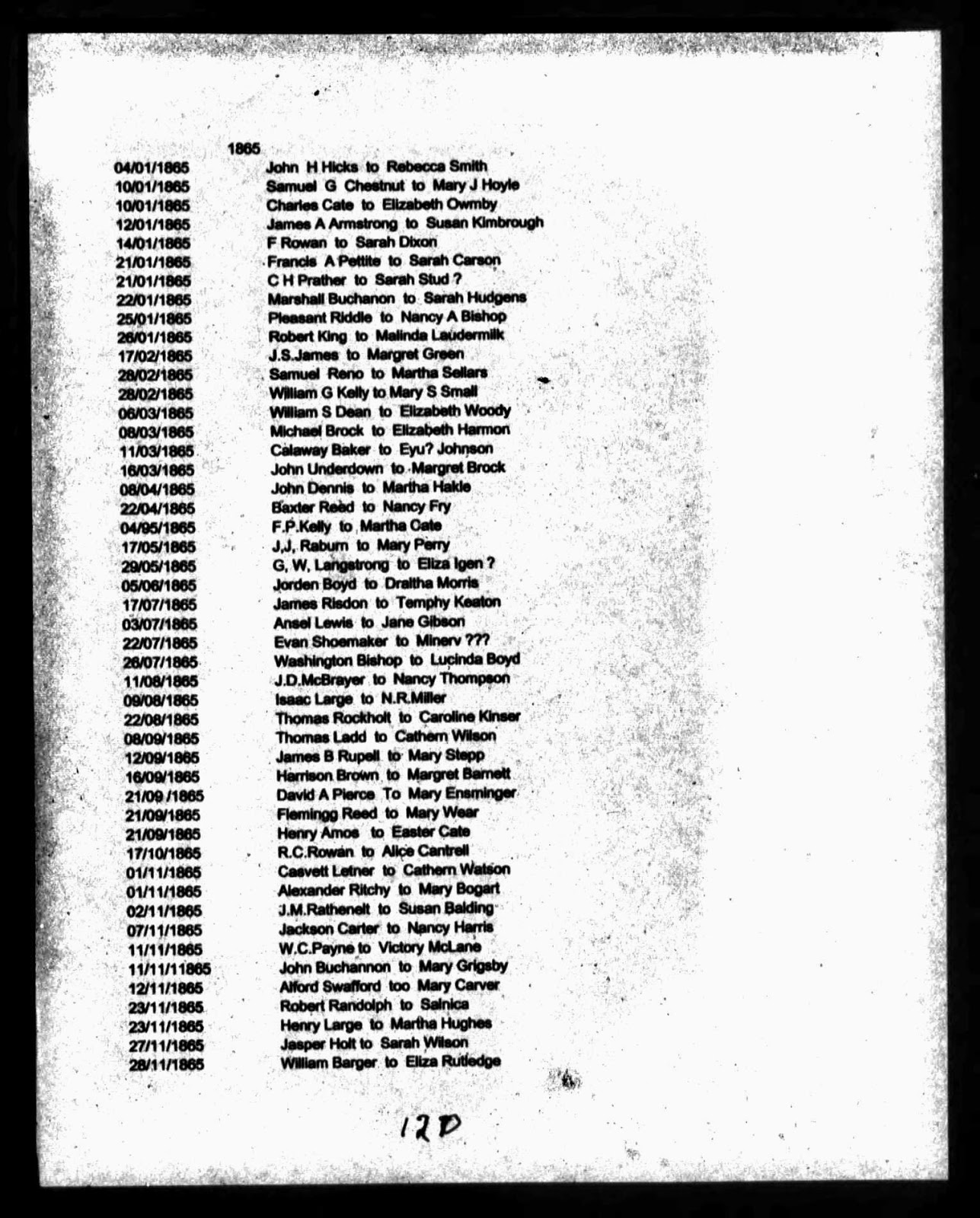
Thomas Rockholt married Caroline Kinsey on August 24, 1865


Thomas Rockholt married Caroline Kinsey on August 24, 1865, McMinn County, Tennessee.  There are several good (and not so good) references for this event:

A photo copy of the original county record indicating a  marriage license was issued on August 22nd and the marriage was on August 25th, before a justice of the peace.

There is a hand written record, probably the county clerks' book, which shows the same information but is indexed as Caroline Kinser.

A typed sheet, listing 1865 marriages in Tennessee, has Thomas Rockholt and Caroline Kinser married on August 22, 1865,

It appears that the original was probably misread, resulting in the wrong spelling of Caroline's name; the date error is obviously a misreading of the license date for the marriage date.  While in this case the differences are not severe, they could certainly result in ones tree having the wrong information.  Even with the best research there is always the chance of error -- we can only do our best to get it right.

Now I need to find exactly who Thomas is and where he fits on the family tree.  I believe he was born around 1845 and died after 1880.  Caroline is actually Rachel Caroline Kinsey.

1880 Dist 3, McMinn County Tennessee Census has Thomas and Rachel C. Rockhold and their children.  Also on the same page I find Nancy A. Rockhold (55 YO) living by herself; James R (36 YO) and Katherine F.S. and kids and William and Celia Rockhold and their son Eli.  Near the first of the census report I found F.M. and Susannah Rockhold and daughter Mary Josaphine in house number 4.

This Nancy A. Rockholt, living by herself, is probably a widow and at age 55 is about the right age to be the mother of most if not all of the boys on this census.  I also see a few "Melton" families on the census, and since I have seen the Rockholt/Melton union before, I suspect this might be Nancy Melton, wife of one William Rockhold/t.  I also see there are a few of the Colbough family, which I have also seen married into the family.